






How To Tell If That Wet Spot In Your Yard Is A Broken Water Line
An August lawn in North Texas has no business being soggy. When the rest of the grass is crunching underfoot and one patch stays dark, soft, and green, that patch is being fed by something, and buried water lines are the usual culprit. A broken water line rarely announces itself with a geyser; it seeps quietly into the soil for weeks while your bill climbs and your pressure drops. Homeowners in McKinney, Princeton, and the surrounding cities often assume the sprinkler system is to blame, then discover the real source only after the water bill triples. The good news is that you can narrow down the cause yourself with a few simple checks before anyone touches a shovel. This guide walks through the signs of a broken water line, the tests that separate a service line leak from an irrigation or sewer issue, and the point where the job needs a licensed plumber. Knowing the difference early saves money, protects your foundation, and keeps a small repair from turning into a full line replacement.
Signs That Wet Spot In Your Yard Is A Broken Water Line
A broken water line under your yard leaves a trail of evidence above ground, and most of it shows up long before the ground actually caves in or bubbles. The main water line runs from your meter at the street to the point where it enters your home, buried anywhere from eighteen inches to four feet deep depending on when the neighborhood was built. Pressurized water escaping from that pipe has to go somewhere, and it follows the path of least resistance through the soil until it surfaces. That surfacing point is often not directly over the break, which is one reason guessing leads to unnecessary digging. Pressure loss, bill spikes, unusual sounds, and shifting soil all point in the same direction when they show up together. Reading those signals correctly tells you how urgent the situation is and how much of the line is likely involved.
A Wet Spot In The Yard That Never Dries Points To A Broken Water Line
The single most reliable indicator of a broken water line is persistence. Rain, a heavy sprinkler cycle, or a neighbor’s runoff will all leave your yard damp for a day or two, but that moisture disappears once the sun and the clay soil pull it away. A wet spot fed by a pressurized line does not dry, because the pipe keeps pushing water into the ground around the clock at sixty to eighty pounds of pressure. Watch the same patch for three or four consecutive days with the sprinklers off and no rain in the forecast, and you will have your answer quickly. If the ground stays spongy and your shoe leaves an impression that fills with water, something is feeding it continuously. That constancy is what separates a plumbing failure from ordinary drainage.
Color and growth patterns tell you almost as much as moisture does. Grass sitting over a leaking supply line often grows faster, taller, and noticeably darker green than the turf around it, because it is receiving a steady drink while everything else bakes. In deep summer this creates a striking stripe or oval across an otherwise stressed lawn, and the shape frequently traces the path of the buried pipe from the meter toward the house. Some homeowners notice the opposite effect on top of a driveway or sidewalk, where water pushes up through expansion joints and leaves a permanent damp stain or a chalky mineral ring. Moss, algae, and mushrooms in a spot that never had them before are another common sign, since those organisms need consistent moisture that a Texas August simply does not provide on its own. Mosquito activity concentrated in one area of the yard often follows for the same reason.
Movement in the soil around the wet area rounds out the picture. Escaping water washes fine particles out of the surrounding dirt and carries them away, which slowly hollows out a void beneath the surface. Over time that void produces a shallow depression, a sinking patio stone, a settling flower bed, or a section of sidewalk that suddenly sits lower than the slab beside it. In the blackland clay that covers most of Collin County, this washing effect combines with the soil’s natural shrinking and swelling to accelerate the damage. A yard that develops a soft dip near the front walk during the driest month of the year is telling you something important. Take pictures as the depression develops, because documenting the progression helps your plumber understand how long the leak has been active and how far the water has traveled.
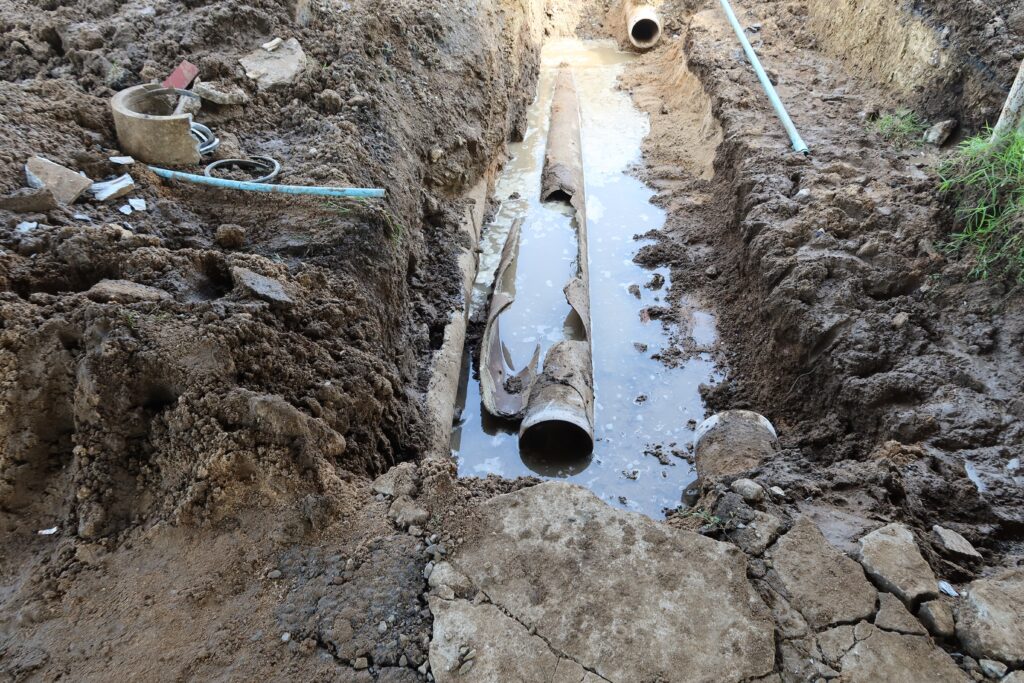
Water Pressure Drops And Bill Spikes That Signal A Broken Water Line
Your water bill is the cheapest leak detector you own, and it works even when the wet spot has not appeared yet. A main water line break wastes water continuously, so the usage number on your statement climbs in a way that has nothing to do with your habits. Compare the current month against the same month from the previous year rather than against last month, since summer irrigation naturally inflates usage and can mask the change. Most North Texas utilities print a twelve month usage graph directly on the bill or make it available through an online portal, and a leak shows up as a step upward that never comes back down. A jump of several thousand gallons with no change in household routine deserves investigation the same week you notice it. Some cities also flag continuous consumption on smart meters and send an alert, so it pays to keep your contact information current with your water provider.
Pressure loss inside the house is the second half of that equation. Water escaping through a break in the service line never reaches your fixtures, and the loss becomes obvious when you run two things at once. Showers that weaken when someone starts the washing machine, faucets that produce a thinner stream than they did last spring, and irrigation zones that no longer pop up with authority all point toward a supply problem upstream of the house. The change often happens gradually enough that families adjust without noticing until a guest mentions it. A simple hose bib pressure gauge from any hardware store costs very little and gives you a hard number to work with. Readings below fifty pounds on a system that used to run in the sixties or seventies are worth reporting to your plumber.
Discolored or gritty water sometimes accompanies the pressure change, and that symptom deserves attention. A break in a pressurized line usually pushes water out, but pressure fluctuations and shutdowns can allow soil and debris to be drawn back into the pipe through the same opening. Rusty water, sand at the bottom of a glass, or sediment clogging your aerators and shower heads suggests the pipe wall has been compromised somewhere underground. Older galvanized steel service lines, still common in homes built before the nineteen seventies, corrode from the inside and eventually perforate in multiple places at once. Polybutylene lines installed between the late seventies and the mid nineties fail at the fittings and along the pipe body with similar unpredictability. If you have either material and you are seeing pressure loss with a wet yard, plan on replacement rather than a spot repair. Suspect a hidden leak but cannot pinpoint it? Click here for our leak detection service.
Sounds, Smells, And Soil Clues That Confirm A Broken Water Line
Sound travels remarkably well through both water and metal pipe, and a broken water line often makes noise long before it makes a puddle. Turn off every fixture and appliance in the house, then stand quietly in a room near where the line enters and listen for a faint hiss, a soft rush, or a whistling that continues with nothing running. Placing your ear against the main shutoff valve or a metal hose bib amplifies the sound considerably, and a long screwdriver held against the valve with your ear on the handle works as a crude listening stick. Professionals use electronic amplification for the same purpose, but the physics are identical. A continuous sound with all fixtures closed means water is moving somewhere it should not be. Note the time of day you hear it best, because street pressure typically rises overnight and makes leaks louder in the early morning hours.
Smell gives you an equally useful clue, and it is the fastest way to separate a supply line break from a sewer failure. Municipal water carries chlorine or chloramine, so water surfacing from a broken supply line smells faintly like a swimming pool, especially where it first bubbles up. Sewage carries an unmistakable sulfur or rotten egg odor that gets stronger as you approach the wet area and lingers on your shoes. Groundwater and irrigation runoff usually smell like nothing at all beyond wet dirt. If the water in the wet spot is clear, cool to the touch, and free of odor, a pressurized supply line is the likely source. Warm, cloudy, gray water with a smell means you are dealing with a drain or sewer problem instead, which changes both the urgency and the repair approach entirely.
The soil around the wet spot fills in the remaining details. Water escaping under pressure tends to erupt rather than seep, so you may see small bubbles rising through standing water, a slight fountain effect after heavy usage in the house, or a fan shaped stain where water has been spraying sideways against a rock or a root. Pay attention to how the wet area behaves when nobody is home using water, since a supply leak continues unchanged while an irrigation issue stops the moment the controller shuts off. Check the curb and the gutter in front of your house as well, because service line breaks often follow the trench line back toward the meter and surface at the street. A steady trickle running from under the curb on a dry day is a strong sign that the leak sits on the utility side or right at the meter connection. Marking the boundaries of the wet area with landscape flags over several days shows you which direction the water is spreading and gives your plumber a valuable head start.
How To Test A Wet Spot In Your Yard Before You Call About A Broken Water Line
Before anyone digs, the wet spot needs a diagnosis, and a handful of tests will get you most of the way there in under an hour. The goal is to answer three questions in order: is water actually being lost, is the loss on your side of the meter, and is the source a supply line rather than irrigation or sewage. Each of those answers narrows the repair scope and the cost dramatically. Homeowners who run these checks before calling almost always get a faster, more accurate visit, because the plumber arrives with the right equipment for the right problem. None of this requires tools beyond a flashlight, a pressure gauge, and patience. What it does require is turning off water in the house completely for a stretch of time, so pick a window when the family can cooperate.
The Water Meter Test For A Broken Water Line In Your Yard
Start at the meter box near the curb, which in most North Texas neighborhoods sits under a rectangular concrete or plastic lid in the parkway strip. Lift the lid carefully with a screwdriver and check for spiders and snakes before reaching in, then wipe the glass clean so you can read the dial. Nearly every modern meter includes a low flow indicator, usually a small triangle, star, or dial that spins at the slightest movement of water through the meter. Shut off every faucet, appliance, ice maker, and irrigation zone in the house, then watch that indicator for several minutes without touching anything. Any rotation at all means water is passing through the meter with nothing running, and that is the definition of a leak. Record the full meter reading, wait two hours with everything still off, then read it again to measure exactly how much water you are losing per hour.
The second half of the test tells you which side of the property the break sits on, and it matters enormously for who pays. Locate your main shutoff valve, which is typically inside the meter box on the house side or at a dedicated valve box near the foundation, and close it completely. With that valve shut, no water can reach the house at all, so the meter should stop moving. If the low flow indicator keeps spinning after you close the valve, the leak sits between the meter and that valve, meaning the break is in the buried service line running across your yard. If the indicator stops the moment you close the valve, water is escaping somewhere past that point, which puts the problem under the slab, in the walls, or in the irrigation system tied in beyond it. This single test eliminates most of the guesswork and steers the entire repair plan.
Interpreting the volume helps you decide how fast to act. A meter that takes ten minutes to advance one gallon is losing roughly one hundred forty gallons a day, which is annoying but not immediately destructive. A meter that spins visibly and continuously can waste thousands of gallons daily, which erodes soil aggressively and threatens your foundation and hardscape. Compare your measured loss against your bill to confirm the numbers line up, and keep that documentation, since many North Texas cities offer a onetime leak adjustment or credit when you provide proof of repair from a licensed plumber. Leave the main valve closed while you wait for service if the loss is severe, and open it only when the household needs water. Doing so protects your yard and gives you real control over an otherwise open faucet running under your lawn. Ready to get the line fixed? Click here for our main water line repair service.

Ruling Out Irrigation And Drainage Before Blaming A Broken Water Line
Sprinkler systems cause an enormous share of the mystery wet spots in Texas yards, and they are worth eliminating first because the repair is far simpler. Most residential irrigation systems tie into the water supply through a backflow preventer near the house or the meter, and they run on their own valves and lateral lines buried only eight to twelve inches deep. A cracked lateral, a stuck valve diaphragm, a broken riser, or a head that fails to seal will produce a soggy patch that looks exactly like a service line break to the naked eye. The distinguishing factor is timing, since a normal irrigation leak only wets the ground while a zone is actively running or shortly after it shuts off. Shut the system down at the controller for a full week and watch the patch, because a wet spot that persists through a dry week with the controller off is not an irrigation problem. Also check the isolation valve on the irrigation supply line and close it, then repeat your meter test to see if the movement stops.
Drainage and grading create the other common false alarm, especially on lots with heavy clay and poor slope. Water from your roof, your neighbor’s downspouts, an air conditioner condensate line, or a swimming pool overflow all collect at low points and sit there far longer than they would in sandy soil. Clay sheds water sideways rather than absorbing it, so a downspout dumping near the foundation can keep a spot damp for days after a storm. Walk your property during and immediately after the next rain and follow where the water actually travels, since the path is rarely what you would assume from looking at the dry yard. Air conditioner condensate deserves special attention in August, because a working system can discharge several gallons a day into the same spot all summer long. If the wet area sits directly under a condensate drain line or a gutter outlet, redirect that discharge and give the ground a week to recover before you conclude anything else.
Pool equipment, water features, and neighboring properties round out the list of things to rule out. A pool with an underground plumbing leak loses water into the surrounding soil and can surface twenty feet away in a flower bed, and the giveaway is a falling water level that outpaces normal evaporation. Uphill neighbors with their own service line break will send water across the property line, so a wet spot along a fence at the high side of your lot warrants a conversation next door. City main breaks and leaking utility valves also surface in the parkway strip between the sidewalk and the street, and those repairs belong to the water department rather than to you. Call your city’s utility line before spending money if the water is surfacing in that public strip. Working through this list methodically takes a few days but frequently saves an unnecessary service call.
Telling A Broken Water Line Apart From A Sewer Line Leak In Your Yard
Supply lines and sewer lines both run underground through the yard, and homeowners regularly confuse the two, but the symptoms diverge in ways you can verify. A supply line carries treated, pressurized water and pushes it out constantly regardless of what happens inside the house. A sewer line carries wastewater by gravity and only leaks when someone flushes, showers, or drains a sink, so the wet spot associated with a sewer break tends to grow after periods of heavy household use and shrink overnight. Odor is the fastest test, since sewage produces a sulfur smell that nobody mistakes for anything else once they have smelled it. Appearance helps too, with sewer leaks producing gray or brown water, occasional paper fragments, and a slick film on the surface. Supply leaks produce clear water that looks and smells like what comes out of your tap.
Indoor symptoms provide independent confirmation. Sewer line failures announce themselves through slow drains across multiple fixtures, gurgling from toilets when the washing machine drains, and drain flies appearing near tubs and floor drains. Supply line failures announce themselves through weak pressure, higher bills, and running meters, and they never affect how fast a sink empties. If your toilets flush sluggishly and your yard smells while your water pressure remains strong, the problem lives on the drainage side of the system. If pressure has dropped and the meter is spinning while every drain works normally, the problem lives on the supply side. Homes occasionally have both at once, particularly older properties with original cast iron drains and galvanized supply lines, which is why a full evaluation beats a quick guess.
The repair paths differ enough that correct identification saves real money. A sewer failure calls for a camera inspection to locate the break, identify root intrusion, and confirm the pipe material and depth before any excavation begins. A supply line failure calls for pressure testing, acoustic or correlator based leak location, and a decision between spot repair and full replacement based on the pipe’s age and material. Digging for the wrong problem wastes an entire day and leaves your yard torn up for nothing. Getting a camera in the drain or a listening device on the supply line first is always cheaper than exploratory excavation. Suspect the problem is on the drain side instead? Click here for our sewer line inspection service.
Why You Need A Licensed Plumber For A Broken Water Line In Your Yard
A broken water line is one of the few plumbing problems that gets meaningfully worse and more expensive every day it goes unaddressed. Water moving through soil under pressure removes support from everything above it, including your foundation, your driveway, your walkways, and any tree whose roots depend on stable ground. Texas law requires a licensed plumber for water service line work, and utility locating rules require professional coordination before anyone puts a shovel or a machine in the ground. Beyond the legal requirements, the diagnostic equipment that pinpoints a break to within a few feet is not something homeowners keep in the garage. A correct diagnosis followed by a properly permitted repair protects your property and your wallet at the same time. Acting in the first week rather than the second month is the single biggest factor in keeping the job small.
What Happens When A Broken Water Line Sits Untouched In Your Yard
Erosion is the first and most serious consequence of an untreated broken water line. Water flowing through clay soil carries fine particles away and creates voids that expand quietly beneath driveways, patios, sidewalks, and foundation edges. Slabs lose their bearing support and begin to crack, doors start sticking, and hairline separations appear where brick meets mortar. Foundation repair in North Texas routinely costs many times what a water line repair costs, and insurance rarely covers damage attributed to a slow leak the homeowner knew about. Every week of delay increases both the size of the void and the scope of the eventual fix.
Water loss adds up faster than most homeowners expect. A break large enough to keep a patch of lawn wet through a Texas August is typically wasting hundreds to thousands of gallons per day, which shows up as a bill that keeps climbing month after month. Some cities issue a courtesy adjustment for a first leak, but only after you provide documentation of a completed repair from a licensed plumber, and only once. Continuing to pay inflated bills while the problem sits unaddressed means paying twice for the same water. The repair frequently pays for itself in avoided utility charges within a season.
Health and safety concerns follow close behind. A depressurized or compromised service line can allow contaminants to enter your drinking water through the same opening that lets water out, particularly during pressure drops or municipal work on the main. Standing water in the yard breeds mosquitoes and creates slip hazards near walkways, and saturated soil around gas lines, electrical conduits, and irrigation wiring introduces risks that have nothing to do with plumbing. Sinkholes and soft spots also present a real hazard for children and pets playing in the yard. Treating a persistent wet spot as a cosmetic annoyance underestimates what is actually happening below the surface.

How Professional Leak Detection Finds A Broken Water Line Fast
Modern leak detection replaces guesswork with measurement, and that difference shows up directly in your final bill. Acoustic listening equipment amplifies the sound of water escaping a pressurized pipe and allows a technician to walk the line and identify where the noise peaks. Correlators use sensors placed at two points on the line to calculate the leak position mathematically based on how sound travels through the pipe. Tracer gas, thermal imaging, and pressure isolation testing fill in the gaps on plastic lines and deep installations where sound carries poorly. The result is a marked spot on your lawn rather than a trench across it.
Accurate location changes the repair method available to you. When a break is isolated to one point on an otherwise sound pipe, a spot repair requires a single small excavation and a few hours of work. When testing reveals multiple failure points or a pipe material known to fail systemically, replacement of the entire service line makes far more sense than repairing the same line repeatedly. Trenchless methods such as pipe bursting and directional boring allow a new line to be installed with two small access pits instead of an open trench across the yard, which preserves landscaping, driveways, and sprinkler systems. Choosing correctly between those options requires knowing exactly what the pipe looks like underground.
Proper repair work also means proper permitting, materials, and restoration. Water service replacements require permits and inspection in most Collin County cities, and using approved materials with correct bedding and depth prevents the same failure from repeating in a few years. A professional crew calls Texas 811 to mark gas, electric, cable, and communication lines before excavation, which prevents a plumbing problem from becoming a utility emergency. Backfill, compaction, and cleanup matter just as much, since poorly restored soil settles and creates new problems within months. Need a new service line installed the right way? Click here for our main water line installation service.
Why Choose Pounce Plumbing For Broken Water Line Repair
Pounce Plumbing is fully licensed, fully insured, and fully accountable for every water line we locate, repair, and replace across McKinney, Princeton, Prosper, Allen, Frisco, Melissa, Anna, Wylie, and the surrounding communities. We charge by the job rather than by the hour, so you know the price before we start and the number does not climb because the clay was harder than expected. Our technicians arrive with acoustic and pressure testing equipment on the truck, which means diagnosis and repair frequently happen in the same visit. We handle permitting and utility locating as part of the job, not as an afterthought. Our five star reviews come from homeowners who got a straight answer and a clean yard.
The Pounce Pass backs our work with a lifetime craftsmanship guarantee, which means the quality of our installation is our responsibility for as long as you own the home. Buried water lines are not something you want to think about twice, so we install with correct materials, correct depth, and correct bedding the first time. We explain what we find, show you the evidence, and walk you through the options between a spot repair and a full replacement without pressure. You get a clear recommendation and the information behind it. That is how we have built a reputation across Collin County one yard at a time.
If a patch of your lawn has stayed wet through the hottest month of the year, stop watching it and let us find out why. We will run the meter test, locate the break, and give you a firm price to fix it before any digging begins. Every day that leak runs costs you water, soil, and eventually foundation stability, and the repair only gets larger with time. Call Pounce Plumbing at (469) 772-5766 or email info@pounceplumbing.com to schedule your water line evaluation, and let us get your yard dry and your pressure back where it belongs.
